

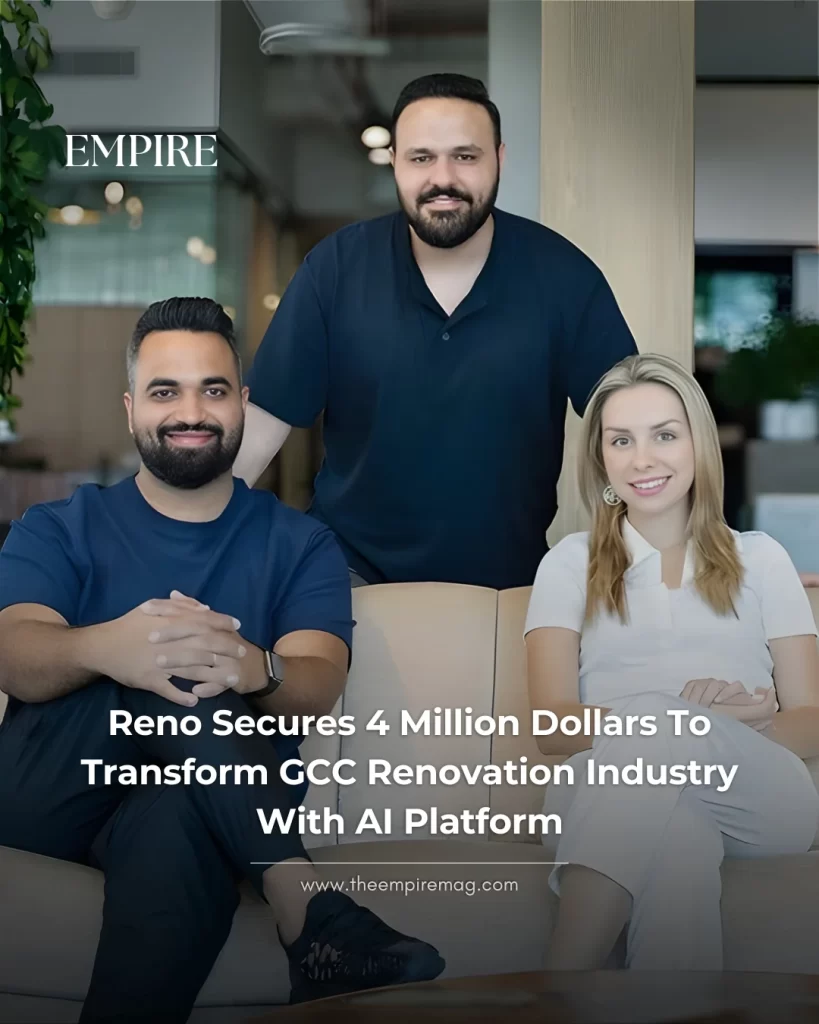
Reno Secures 4 Million Dollars To Transform GCC Renovation Industry With Al Platform
UAE-based renovation technology company Reno has secured USD 4 million in fresh capital through a structured mix of debt and equity, marking a significant milestone in its mission to modernize and streamline the home and commercial renovation market across the Gulf Cooperation Council. The funding round underscores growing investor confidence in technology-led transformation within the traditionally fragmented construction and renovation sector.
The round saw participation from Abu Dhabi’s global tech ecosystem Hub71, alongside regional and international venture capital firms including Plus VC, Zero 100 VC, FlyerOne Ventures, Sandstorm VC, AngelSpark, and Swizz Founders Fund. The diversity of the investor base reflects strong cross market interest in scalable proptech platforms capable of delivering operational efficiency and financial innovation.
Scaling an AI-Driven Renovation Ecosystem
The newly secured capital will primarily support the launch of Reno’s next-generation mobile application, scheduled for release in early 2026. The platform is designed to offer real-time design visualization, intelligent budgeting tools, and AI-powered materials planning, enabling property owners to make data-informed renovation decisions with greater accuracy and cost control.
By integrating artificial intelligence into procurement, cost estimation, and project sequencing, Reno aims to eliminate the inefficiencies that commonly plague renovation projects, such as budget overruns, timeline delays, and fragmented contractor coordination. The company’s end-to-end digital infrastructure seeks to centralize the entire renovation lifecycle within a single technology ecosystem.
Beyond product development, the funding will also accelerate geographic expansion across the UAE and the broader GCC region. Reno intends to strengthen its operational footprint while further enhancing its technology stack to bring standardization, transparency, and scalability to renovation management.
A One Stop Platform for Modern Renovation Needs
Founded in 2024 by Marc Michel, Amr Hosny, and Farah Karabeg, Reno was built to address structural inefficiencies in both residential and commercial renovation markets. The founders identified a clear gap between client expectations and contractor execution, particularly in areas such as cost predictability, project transparency, and financing accessibility.
Reno operates as a comprehensive renovation marketplace and management platform, covering the full pipeline from design conceptualization to contractor execution and financing. Its integrated approach enables property owners to manage architectural planning, contractor selection, procurement, and payment structuring within a unified digital interface.
A key differentiator is the company’s renovate now, pay later model, which introduces embedded financing options into renovation projects. This feature is particularly relevant in markets where renovation costs can be significant and upfront capital constraints often delay or limit property upgrades. By combining technology with financial flexibility, Reno positions itself at the intersection of proptech and fintech innovation.
Positioning for Regional Transformation
The renovation and construction sector across the GCC continues to expand, driven by urban development, commercial growth, and rising consumer expectations for premium interior spaces. However, the industry remains highly fragmented, with limited digitization and minimal process standardization.
Reno’s strategy is to leverage artificial intelligence, centralized project management tools, and embedded financing to formalize and professionalize the renovation ecosystem. If successfully executed, the model could redefine how property owners, contractors, and suppliers collaborate across the region.
With institutional backing, a clear technology roadmap, and a scalable regional vision, Reno is positioning itself as a leading force in transforming renovation from a traditionally manual process into a data-driven, transparent, and customer-centric experience.